
Check Newton County's Owner-of-Record Card
Newton's parcel card is the best snapshot. The assessor ties the owner label to the parcel number, situs, mailing address, legal description, tax district, acreage, subdivision, values, and sale history. Nothing else matches that breadth. Read the tax year beside the result, because the roll is an annual record, not a live closing feed.
| Owner name | The current owner label on the selected tax roll |
|---|---|
| Mailing address | Where assessment and tax correspondence is sent |
| Situs address | The physical location assigned to the parcel |
| Parcel and legal description | Keys used to verify that the record is the right land |
| Last sale and deed reference | A bridge to the newest recorded conveyance |
| Tax year | The annual context for the displayed owner field |
Owner of record does not mean occupant. The mailing and situs addresses sit in separate fields, and the owner may be an LLC, a trust, an estate, or someone who simply receives mail elsewhere.
Verify Newton County's Current Owner Against the Deed
The Newton Tax Office Property Search shows the owner field. Check the Clerk's index too. Testing both records matters most after a recent sale or whenever names disagree.
- Capture the assessor owner name, parcel ID, situs, mailing address, tax year, and last sale.
- Search the owner and spelling variants in the Newton Clerk Real Estate Search.
- Match the newest deed's grantee, recording date, legal description, and book/page or instrument number.
- Record any unresolved lag, entity name, estate role, or corrective instrument.
- Owner of record
- The party named on the official roll or latest matched instrument.
- Assessment roll
- The annual parcel and value record used for taxation.
- Recording lag
- The interval between closing, deed recording, and an assessor update.
Measure How Current the Newton County Owner Field Is
Georgia fixes January 1 as the tax date. Property taxes attach to the owner of record on that day, so a Newton County tax card can show a prior owner well after a later closing. The county publishes no fixed update interval. Note instead the assessor tax year, the date shown on the card, and the coverage date the Clerk's index displays. The Clerk's remote index reaches September 1, 2026. A just-recorded deed can thus prove the present grantee better than an older annual roll. The parcel and legal description must match.
Newton County's qPublic page is the official parcel entry point for owner-of-record context.
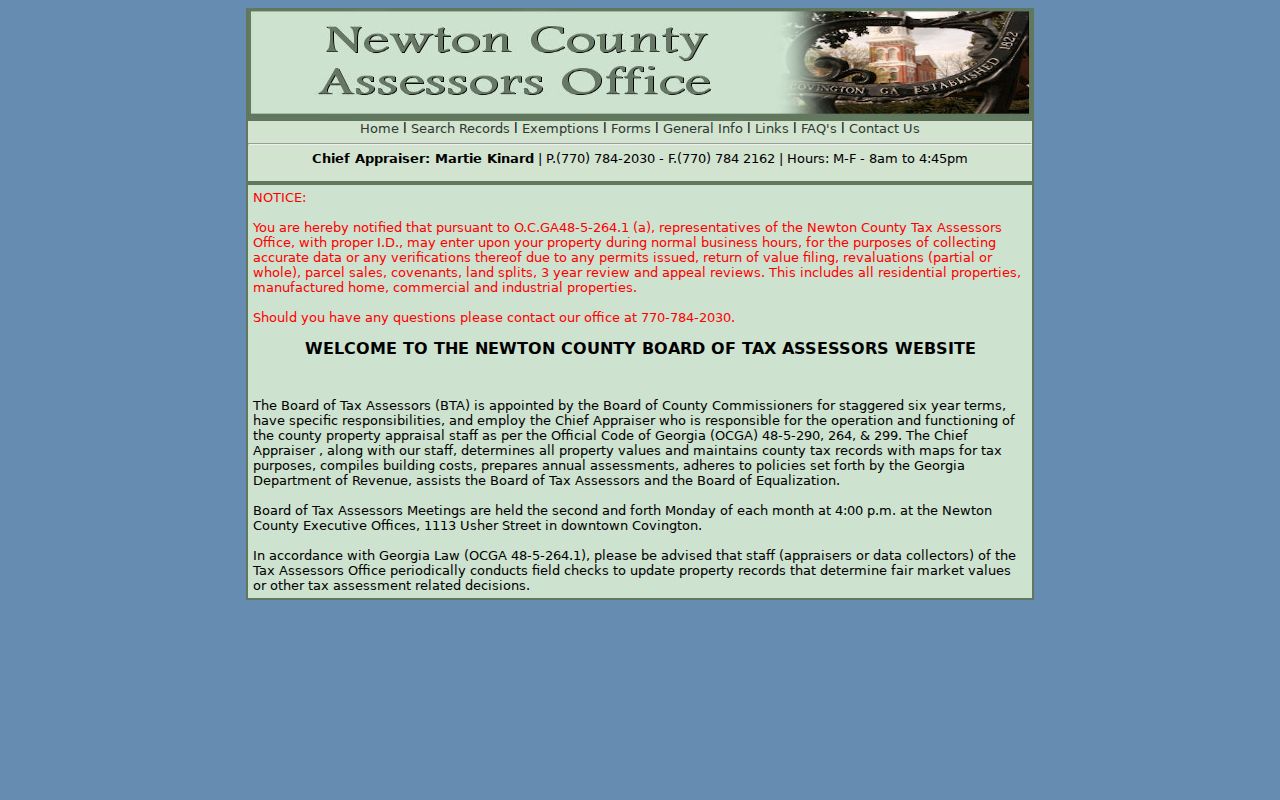
Date the tax card, then check the Clerk index.
Resolve a Newton County Name Conflict
Newton County deed records show name conflicts with ordinary causes. Punctuation, initials, and married names create mismatches. So can a pending filing, a corrective deed, an estate, or an entity name change. Search every reasonable variant in the Clerk's deed index. Compare both sides of any corporate transaction before deciding. A registered agent, permit applicant, or tax-mail recipient is not the owner of record. The deed and parcel facts must support that conclusion. For an LLC, Georgia eCorp preserves the exact entity name and control number. Its filing history cannot replace the deed.
Use Newton County Certification When Reliance Matters
Certified Newton County real-estate records come from the Clerk. Its 24/7 eCertification service covers court and real-estate records. You can also visit Room 338 of the Judicial Center at 1132 Usher Street in Covington, or call 770-784-2035 during published weekday hours. Confirm the current certification and image charge before ordering.
FANS filing alerts add a free monitoring layer. The notice warns that alerts may be incomplete or inaccurate, so a notification is a cue to inspect a filing, not proof that ownership changed.
Capture Newton County Current-Owner Evidence
A defensible note starts with the basics. Record the owner field, parcel number, situs and mailing addresses, legal description, tax year, latest deed date, and recording reference, along with the date each Newton County system was consulted. That compact inventory lets another reader reproduce the current-owner conclusion from the property records themselves.
Conflicts happen. Do not erase either date. If the assessor shows one name for the selected year while the newest matched deed names a different grantee, say exactly that in writing, so the lag between the tax roll and the deed records stays visible.
Keep Newton County Permits Separate from Ownership
A city or county permit can name almost anyone. The applicant, contractor, tenant, agent, or project contact may appear, yet none of them is automatically the owner of record. Match the permit's address and parcel number to the assessor card first, then let the newest deed settle the question of recorded ownership.
This distinction matters in Covington and other municipalities. Local planning records sit apart from county assessment and deed systems. Jurisdiction decides which office holds the permit, while the Newton Clerk remains the custodian of county land records and deed records.
Use Newton County Owner Details with Care
Treat the tax mailing address as a contact clue, not proof of residence. Safe at Home and other Georgia protections can keep an at-risk person's actual address out of public property records. Report only the facts needed to identify the parcel and its owner of record label.
Recent-sale caution. The Newton County assessment roll can lag a closing. Confirm the latest recorded deed before stating who owns the parcel now.
Newton County property records make owner details useful for lawful aims like estate work, fraud prevention, or due diligence on a parcel. Never use owner data to harass, threaten, or expose protected personal information.
The assessor's sale table holds real conflict clues. It lists sale date, deed book, plat page, price, qualification, reason, grantor, and grantee. Compare those rows to the newest indexed deed before assuming the final line was a completed market transfer. Corrections, exempt transfers, estate conveyances, and parcel splits often call for reading the instrument and checking its legal description.
When the portals cannot resolve the present owner, go straight to the offices. The Assessor sits in Suite 102 at 1113 Usher Street NE, Covington, phone 770-784-2030. The Clerk is in Room 338 at 1132 Usher Street, phone 770-784-2035, and publishes weekday hours of 8:00 a.m. to 4:45 p.m. Bring the parcel ID, situs, owner name variants, and deed reference with you.
The county's Open Records form can request an existing permit log or digest export. Newton routes deeds and liens to the Clerk, though. Do not ask the county to decide ownership or build a new report. For certified proof, use eCertification or the counter, confirm the current charge, and keep the certification details with the record date.
A sound current-owner note captures the owner field, parcel ID, situs and mailing addresses, legal description, tax year, latest deed date, recording reference, and inspection dates. When sources conflict, say so plainly. Note that the assessor lists one name for the selected year while the latest matched deed names another grantee. Both facts stay on record, and the timing gap stays clear.
Treat the assessor's historical sale row as a lead, not a deed abstract. Qualification and reason codes can flag a non-market transfer. A deed book or plat reference may still need direct review. Use the card as the primary current-owner record, then open only the latest deed needed to confirm the present grantee.
Copy an LLC or corporate owner label exactly as it appears. Georgia eCorp can display the entity's control number, status, formation date, principal office, registered agent, annual registrations, and available filings. Those details help untangle name variations. Remember that a registered agent or officer is not automatically a beneficial owner of the Newton parcel. The deed remains the land link.
Estates need extra care. Identify the executor or administrator capacity, then locate the recorded conveyance or other instrument that actually moved the property. A probate appointment alone never retitles land silently. Keep the decedent, the representative, the assessor owner label, and the deed grantee as separate facts until documents tie them together.
Before trusting any current-owner result, repeat the parcel match across situs, APN, legal description, acreage, and deed reference. Save the live coverage date and the selected tax year. If any key differs, call the custodian rather than forcing the records into agreement.