
Find Out Who Owns a Newton County Property
Begin with the Newton County tax roll. Finish with the recorded instrument. The assessor serves as the practical address-to-name bridge, while the Clerk of Superior Court holds the land-record authority over every deed and plat. Keep the parcel number and legal description close at hand, because a similar name or a nearby address can otherwise pull you toward the wrong tract entirely.
- Enter the address in the Newton Tax Office Property Search and copy the owner name and parcel ID.
- Search that name in the Newton Clerk Real Estate Search and inspect the newest deed.
- Match the grantee, legal description, recording reference, and parcel clue.
- For an entity, verify its legal name and control number in Georgia eCorp.
Trace Newton County Ownership to Its Source
Three county systems answer different parts of the ownership question. The assessor supplies the current tax-roll label, GIS locates the parcel on the map, and the Clerk index supplies the recorded conveyances. Each answers only its own question, so none should be silently substituted for another.
| Source | Owner Info It Gives | Access |
|---|---|---|
| Assessor roll | Owner name, mailing address, parcel ID | Free public portal |
| Clerk deed index | Newest recorded grantee and instrument | Free remote index |
| Georgia eCorp | Entity name, status, agent, control number | Free state search |
| GIS parcel viewer | Parcel location and mapped owner label | Free county viewer |
The named owner is not proof of occupancy. A mailing address may lie elsewhere. A permit applicant, likewise, is not automatically the owner of record. Report only the record fact needed for the property question at hand.
Use Newton County's Field-Rich Owner Search
The Newton Tax Office Property Search offers several ways in: owner, address, ID, and advanced modes. The fields cover street number and name, property ID, geographic ID, property type, subdivision, neighborhood, DBA, and tax years 2016 through 2025. When searching a street, skip the prefix, suffix, and unit number, just as the local form directs.
Write down the owner name, parcel number, situs and mailing addresses, legal description, last sale, and deed reference. If the portal will not load, call the Assessor at 770-784-2030 or visit 1113 Usher Street NE, Suite 102, Covington.
The county-linked qPublic entry page offers another official route into Newton County assessor and map data. It reaches the same parcel and tax-roll material through a different door.
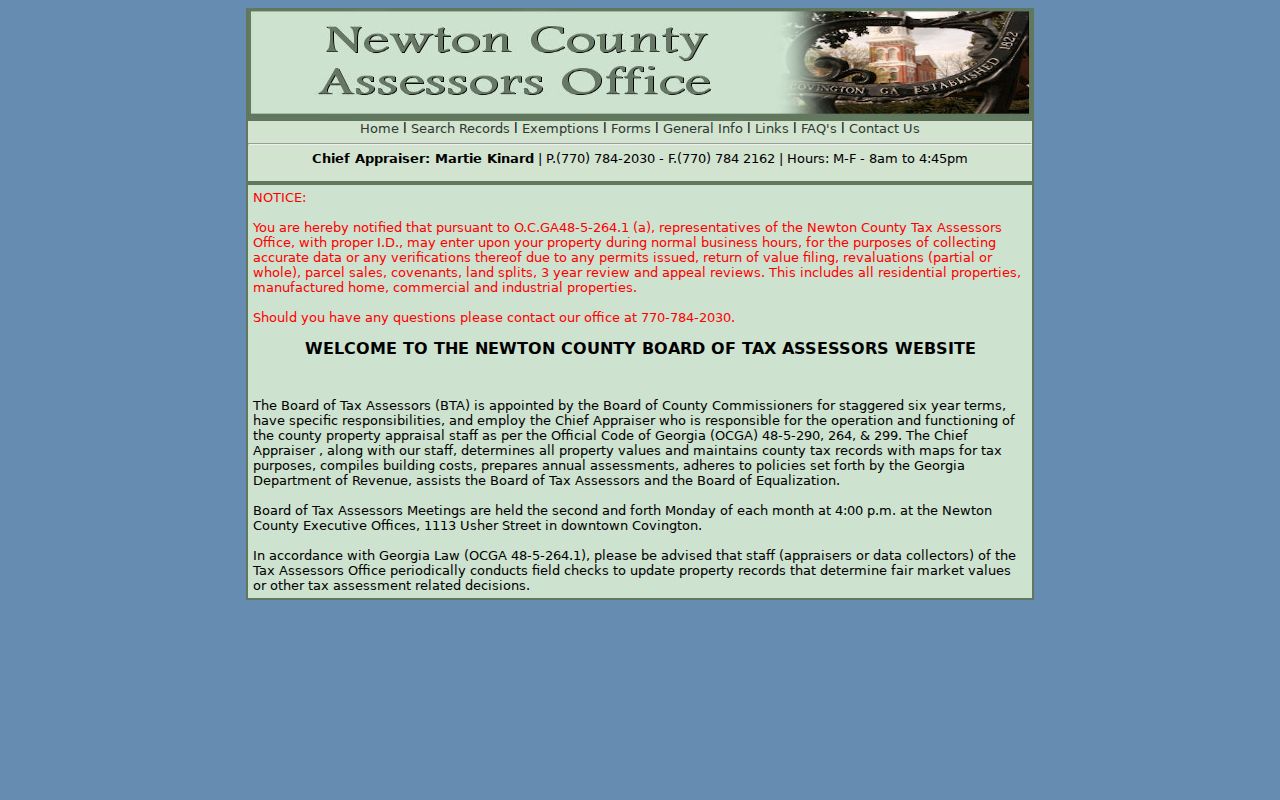
That entry point reinforces a habit worth keeping. Pair the parcel card with the Clerk's latest recorded deed before naming an owner of record conclusively.
Verify the Newton County Grantee
The Newton Clerk Real Estate Search is party-indexed. The system itself warns users to try spelling variations. Its indexes cover deeds and liens through September 1, 2026, and plats through September 2. Match the latest grantee against the tax-card owner. Also check the legal description and the book/page or instrument number. If remote results stay unclear, use the Clerk's terminals in Room 338 of the Judicial Center. Older books are there too, at 1132 Usher Street, Covington, weekdays 8:00 a.m. to 4:45 p.m. The county Open Records form is not the deed route.
Follow a Newton County Entity or Estate Branch
Check an LLC in the Georgia eCorp search by legal name or control number. Status, agent, annual filings, and name changes may explain a mismatch. The registered agent is not necessarily the landowner, though. A trust label also does not disclose beneficial interests. For an estate, separate probate authority from the recorded transfer. The executor or administrator deed, assent, or other filing moves title. State the tax-roll label, the probate role, and the deed grantee separately. This is a practical path for heirs. It is no shortcut around the recorded chain of title.
Monitor Newton County Property Filings
The Clerk promotes the free, voluntary Filing Activity Notification System. FANS alerts may not be complete or accurate, so treat each notice as a prompt to inspect the actual filing. The Alcovy Circuit's 24/7 eCertification service is a separate route for certified records.
Explain a Newton County Ownership Mismatch
A January 1 tax-roll owner and a later recorded grantee can both be valid facts drawn from different dates. The same is true of an entity filing and a probate representative. Build the answer as a short evidence ladder. List the assessor listing and tax year first. Add the newest deed and its recording date. Then note any entity or estate branch, and finally any unresolved gap. This keeps a plausible portal label from hardening into an unsupported title conclusion. When Newton County records disagree, search initials and punctuation-free company names. Also search married and unmarried names and representative terms. A correction or later transfer may resolve the conflict. If not, say which official record was last inspected. Note what certified or professional review still remains.
Know the Limits of a Newton County Owner Answer
A tax-roll name can lag a recent closing because Georgia taxes are charged to the owner of record as of January 1. A deed may be pending, corrected, held by an entity, or followed by an estate filing. Georgia confidentiality protections can also shield an at-risk person's actual address.
Lawful use. Use Newton County owner records for property research and due diligence. Never use public details to harass, intimidate, or harm a person.
An owner lookup is not a title search. It does not prove residence, control, or every beneficial interest. Seek a certified deed or qualified title review when legal reliance matters.
Offline help starts at the counter. The Assessor sits at 1113 Usher Street NE, Suite 102, Covington, while the Clerk's Real Estate Division is at 1132 Usher Street, Room 338. Each office owns different records, and the assessor answers parcel-card and annual-roll questions while the Clerk handles recorded deeds, liens, and plats. Call first, since staff can confirm hours, identifiers, copying options, and whether an older item lives only in a terminal or book. Ordinary agency records move through the Newton County Open Records process. Deeds and property liens are different. The county expressly routes those to the Clerk. For a permit log, GIS dataset, or administrative record, state the parcel, office, record type, date range, format, and certification need. The county may charge search and production costs after the first fifteen minutes. It charges ten cents per letter or legal page.
An image and a certified deed differ. The remote landing page describes free inspection of data and images, but separate Clerk instructions indicate some images may be purchased, so confirm the live checkout price. The GSCCCA schedule lists the statutory fees. For a purchase, estate, or fraud dispute, rely on the certified instrument and qualified title guidance. Keep a dated ownership worksheet. Log the assessor's tax year, owner label, parcel ID, situs and mailing addresses, newest deed date, grantee, legal description, and recording reference. Fields sometimes conflict. Report both official results and the unresolved reason. Do not just trust the newer-looking portal.
The parcel card carries a lot. Expect the owner name, mailing and situs addresses, property ID, geographic ID, legal description, acres, subdivision, neighborhood, homestead code, values, improvements, and sale history. Not every field proves ownership. Together they confirm that an address search found the intended land. Save the tax year you selected. Drop private details unrelated to the question. The deed check deserves the same care. Preserve record type, grantor, grantee, recording date, book/page or instrument number, legal description, and parcel cross-reference. Search spelling variants, initials, married names, punctuation-free entity names, and trustee or executor capacities, and never skip an intervening corrective deed, estate instrument, or tax deed just because another record shows a more familiar name. GIS helps orient the parcel. Newton County warns that its mapped lines are not evidence of boundaries or legal facts, and a map owner label never replaces the assessor field or deed. Compare the parcel ID, acreage, subdivision, lot, and recorded plat when the search may have hit the wrong tract. A real boundary issue needs a survey.
FANS watches for fraud after the owner is identified. Set the alert with careful name and property information. Any notice should still be reviewed independently in the Clerk's index. The service is voluntary and does not guarantee complete or accurate alerts. A missing email is not proof. Date and source your final answer. Say the assessor lists one owner for a named tax year, or say the latest matched recorded deed names a grantee on a stated date. That wording leaves room for recording lag, an entity or trust, probate activity, and later corrections, and it tells the reader which official step to repeat. Do a final identity check before sharing anything. Confirm the county, parcel ID, situs, legal description, and record dates. Strip unrelated personal detail. A precise property-owner answer is narrow, reproducible, and honest about any unresolved difference between the roll and deed.