
Newton County Deed Record Types
Deeds are the instruments that move ownership. The Newton County Real Estate Division also records security deeds, liens, assignments, releases, easements, and plats, each one documenting some other right or claim tied to a parcel.
| Deed Type | What It Does | Common Use |
|---|---|---|
| Warranty deed | Conveys title with stated covenants | Arm's-length sale |
| Quitclaim deed | Conveys the signer's existing interest | Interest cleanup |
| Security deed | Secures an obligation with land | Loan collateral |
| Executor or administrator deed | Conveys through estate authority | Probate transfer |
| Tax deed | Records a tax-sale conveyance | Delinquent tax process |
A security deed or lien never transfers ownership. Before treating a recorded claim as live, look for a later release, satisfaction, cancellation, assignment, or transfer tied to the same parties and filing reference in the deed records.
Newton Deed Index Coverage
The Newton County Real Estate Search covers deeds, liens, and plats. Its land records reach back to 1821. Handwritten indexes end in 1982. Digital indexes begin in 1983, and the portal itself lists deeds and liens through September 1, 2026, and plats through September 2, 2026. Spellings trip up more searches than anything else. Test initials, married names, trustee or executor roles, and company names stripped of punctuation. Then save the portal through-date beside each result you keep.
Newton Deed Index Fields
The Newton County deed portal is party based. Results should preserve enough detail to relocate a filing.
Match each result to its parcel before relying on it.
| Index fact | Meaning | Use |
|---|---|---|
| Party and role | Grantor, grantee, indexed party | Next name search |
| Record class | Deed, lien, plat, related filing | Separates transfer from claim |
| Book/page or instrument | Recorded locator | Requests exact image |
| Dates | Execution and recording | Orders the chain |
| Legal description | Land conveyed | Matches parcel and plat |
Newton County Grantor-Grantee Chain
Start from the newest owner of record you can confirm. Each deed names the prior grantor. Search that name next as a grantee, matching the legal description every time, because one party in the Newton County deed records may hold several tracts.
- Find the current owner's acquisition as grantee.
- Copy its grantor, dates, reference, and land description.
- Search that grantor as an earlier grantee and repeat.
- Move to handwritten books and counter help before 1983.
- Grantor
- The party conveying an interest.
- Grantee
- The party receiving an interest.
- Chain of title
- The ordered series of transfers for the same land.
- Book/page or instrument
- The Clerk's locator for one filing.
Early Newton County Deed Names
Newton County dates to 1821. Its seat began as Newtonsboro and became Covington in December 1822, so search both names in early deed records and archive collections. Historic communities can help too. Brick Store, Winton, Almon, Rocky Plains, Salem, Starrsville, and Porterdale often lead to plats or newspaper references tied to a parcel. Old names linger in family papers.
Note: place-name clues are a search aid, not proof of title, so verify any finding in the original deed, plat, or other primary record.
Newton County Filing Alerts
The free FANS service sends voluntary filing-activity notices for a name or property you choose. A free account is required. The program itself warns that notices may not be complete or accurate. So let each alert lead back to the actual deed record rather than end the search.
FANS is not eCertification. One watches new activity. The other supplies an authenticated record on request, and neither one guarantees title.
Newton Deeds Beyond the Web
Older deeds often need the courthouse. The Clerk counter sits at 1132 Usher Street, Room 338, in Covington, with weekday hours from 8:00 a.m. to 4:45 p.m., and its terminals and deed books are the fallback for older or hard-to-index names. Call 770-784-2035 to confirm copy, search, mail, image, and certification charges.
Clues live beyond the courthouse. The Newton County Library Heritage Room, Digital Library of Georgia directories, the FamilySearch catalog, and Georgia Archives can supply names, dates, and book-and-page leads. Bring the legal description and a narrow date range. Verify every hit against the original recorded volume.
Read a Newton County Deed
A Newton County deed starts with its caption and parties, but that is only the surface. The granting clause states what interest moves. The legal description identifies the land through land lot, district, subdivision, lot, plat, metes and bounds, or a reference to an earlier instrument. Compare that text with the parcel card and the recorded plat. A street address may appear for convenience but does not control the conveyance.
Keep execution and recording dates separate. Execution marks the parties' signatures; recording marks entry into the public record. Retain the notary and witness block, return address, transfer-tax or consideration clues, and every exhibit. Hold the preparer details as well. A corrective deed cites the prior instrument. It often explains a changed name, a redrawn description, or a simple clerical error.
Never infer more warranty than the instrument states. A quitclaim conveys only what the grantor holds, if anything. An executor or administrator deed should be read with the estate authority that supports it, and a tax deed, born of a statutory delinquency process, can remain subject to redemption and later title work.
Newton Liens and Releases
The Real Estate Division indexes far more than deeds. Its dockets hold liens, plats, UCC and BPA filings, partnerships, and hospital liens. For a security deed or mortgage filing, search the property owner. Search the lender or claimant too. Then look for a cancellation, release, satisfaction, assignment, or transfer. It should be tied to those same parties and recording reference.
A release may show up under a later servicer name after an assignment. Name variants matter here as much as in a deed chain. Save the original obligation reference. Compare it with the later instrument's stated book and page or number. An online release may not appear. Run a broader index and counter check before assuming a debt remains due.
Court and land records can overlap. A dispute may produce a lis pendens, judgment, foreclosure, or quiet-title order. The court docket identifies the case. The real-estate index shows what was recorded against the land. Search both and request the actual documents. Sealed case material and legally protected information stay outside ordinary public access.
Newton Deed Image Access
The Clerk's remote page opens data and image access. Images may carry a purchase charge. Verify the current image, certification, mailing, and assisted-search fees with the office before any checkout. The statewide GSCCCA fee schedule cross-checks statutory recording and certified-record charges.
At the counter, the Clerk accepts cash, money orders, and attorney or business checks. Personal checks are refused. An older local report touted a cheap courthouse copy against an expensive private deed-copy solicitation, an amount that belongs to history rather than today's fee list. Call the Clerk. Get the record from the custodian.
The official Newton Clerk search screen marks the remote land-record entry point. Its coverage notices are on display.
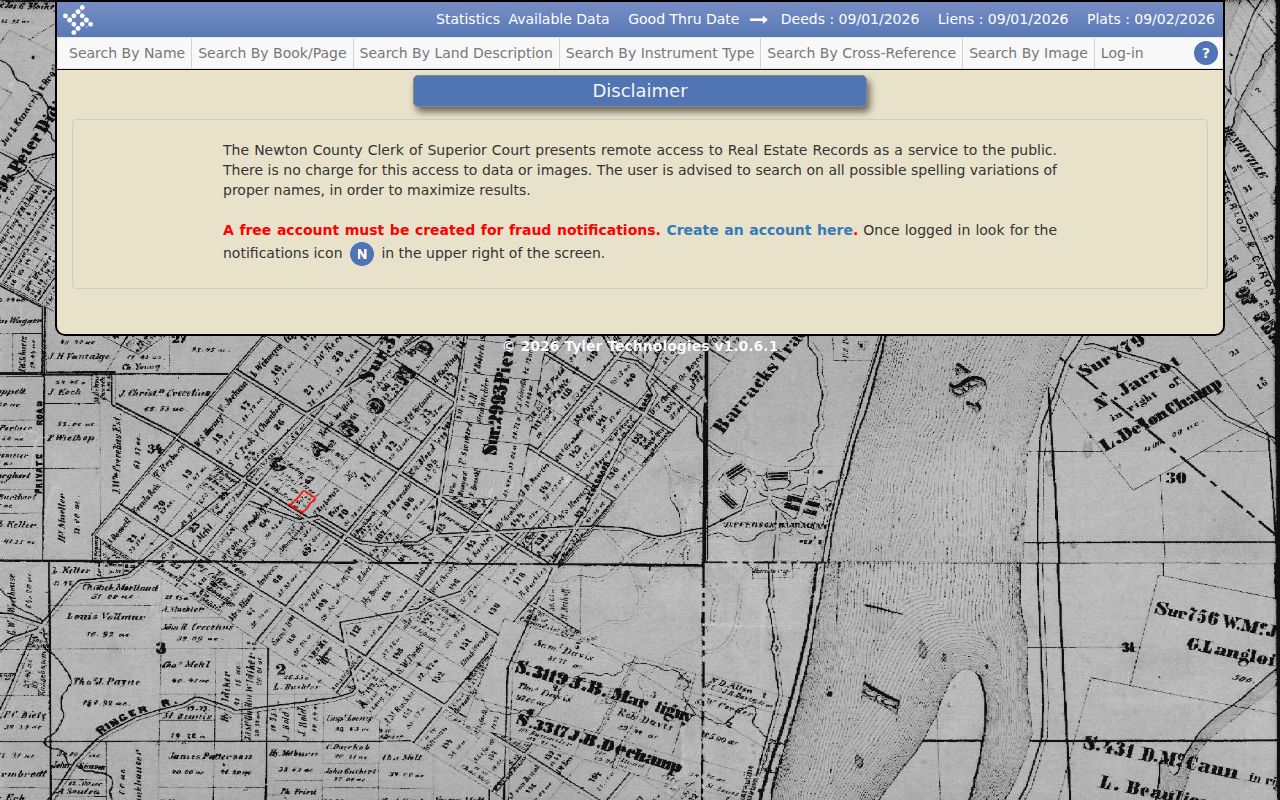
Recheck the live portal for through-dates and image terms. It also governs search controls and notification access.
Newton County Plat Connections
A deed often points to a recorded plat. It does not spell out every course and distance. Copy the references exactly. That means plat book and page, subdivision, lot, block, land lot, and district. All are as written in the deed. Then pull the Clerk's plat class and compare the drawing against the deed's legal description. The assessor's parcel number works as a modern cross-reference. It does not replace the recorded description itself.
Newton County GIS helps you see the parcel in context. Streets, aerial imagery, flood zones, topography, and districts all appear in one view. The county says it plainly. GIS lines are not evidence of legal boundaries, landmarks, or topography. A recorded plat is stronger filed evidence. When a line must be established on the ground, a licensed survey is required.
Lot splits, combinations, corrective plats, and road-name changes add up. They can make a modern tax parcel look nothing like an older deed tract. Follow the legal descriptions, not the shape on a map. One deed may have conveyed a parent tract decades ago. Later plats and deeds may be needed. They account for the parcel as it exists today.
Newton Estate Deed Links
An owner who dies does not vanish from the land record. The ownership trail may run through Newton County Probate Court authority first. From there the transfer moves by executor deed, administrator deed, year's-support order, or assent. It can also move by another recorded transfer. Search the decedent and the estate name. Search the personal representative, any heirs named in public filings, and the acquiring grantee too. Keep the probate case number separate from the deed's book and page.
A will or estate docket can show where the authority came from. The deed index, though, tells you whether an instrument affecting the parcel was ever recorded. Match the legal description instead of assuming every estate asset took the same route. Certified vital records face separate statutory access limits. They do not belong to an ordinary deed request.
A broken deed chain at an estate has a fix. Ask the Probate Court for the public estate file. Ask the Clerk for the land instrument. Older names and dates are harder. The Digital Library of Georgia, the Newton County Library, and the Georgia Archives can help. Historical context supports the search. The original court and deed records support the conclusion.
Copies of Newton County Deeds
The remote page calls its data and images free. Separate Clerk instructions say some online images may be purchased. Confirm the live charge before checkout. Plain copies remain available at the counter. The 24/7 eCertification service handles certified court and real-estate record requests. Give the office the parties and the instrument type. Include the record date and the book/page or instrument number. Ask whether the result is plain or certified, and keep the certification page.
Recorded, not guaranteed. Newton County deed records show filed instruments, not every unrecorded interest, and do not provide a title opinion.