
Trace Former Newton County Owners Transfer by Transfer
Newton County property records hold the story of every piece of land in the county, including who owned it before the current owner of record. Finding former owners means walking a deed chain backward through the recorder's indexes. You can search Newton County property records by address or by owner name to start. Older books, changed place names, and estate transfers can slow the trail. That is normal. Directories and archives help fill gaps, though only a recorded deed proves a transfer.
| Source | Years It Covers | Where Held | What It Shows |
|---|---|---|---|
| Digital grantor-grantee index | 1983 to current display | Newton Clerk remote search | Parties, dates, deed references |
| Handwritten deed indexes | 1821 through 1982 | Clerk counter and books | Earlier grantor and grantee trails |
| Recorded plats | By recorded volume | Clerk Real Estate Division | Subdivision and lot context |
| Directories and local history | Collection-specific | Newton Library and archives | Corroborating names and addresses |
The digital starting point is the Newton Clerk Real Estate Search. When the trail runs out of the digital deed records, shift to the handwritten courthouse indexes. Library and archive sources can corroborate the recorded chain, but they cannot replace it.
Reconstruct the Newton County Deed Chain Backward
Search by party names rather than by street address, since Newton County's older indexes were never built around addresses. Expect spelling variants. Initials, punctuation, maiden or married names, and representative roles like trustee, executor, or administrator may each require a separate search under the recorder's system.
- Locate the current acquisition deed with today's owner as grantee.
- Copy its grantor, date, deed type, legal description, and recording reference.
- Search that grantor as an earlier grantee and match the same tract.
- Repeat until the chain reaches handwritten indexes, then continue in the books.
- Grantor and grantee
- The parties conveying and receiving the stated interest.
- Chain of title
- The linked sequence of recorded transfers affecting the land.
- Legal description
- The stable land description used when street labels change.
Cross Newton County's 1983 Index Divide
Newton County land records reach back to 1821. Handwritten indexes carry the deed records through 1982, and digital indexes take over in 1983. The remote index lists deeds and liens as good through September 1, 2026. That cutoff does not put every early deed online. Plenty of pre-1983 material lives only in the books. For those, use the Clerk's terminals and volumes in Room 338 of the Judicial Center, 1132 Usher Street, Covington. Counter hours run weekdays from 8:00 a.m. to 4:45 p.m. Call 770-784-2035 before a long trip.
Time-depth limit. The digital index begins in 1983. Earlier Newton County owners require handwritten indexes and deed books.
The Newton Clerk remote index is the digital first stop for tracing previous owners in Newton County property records.
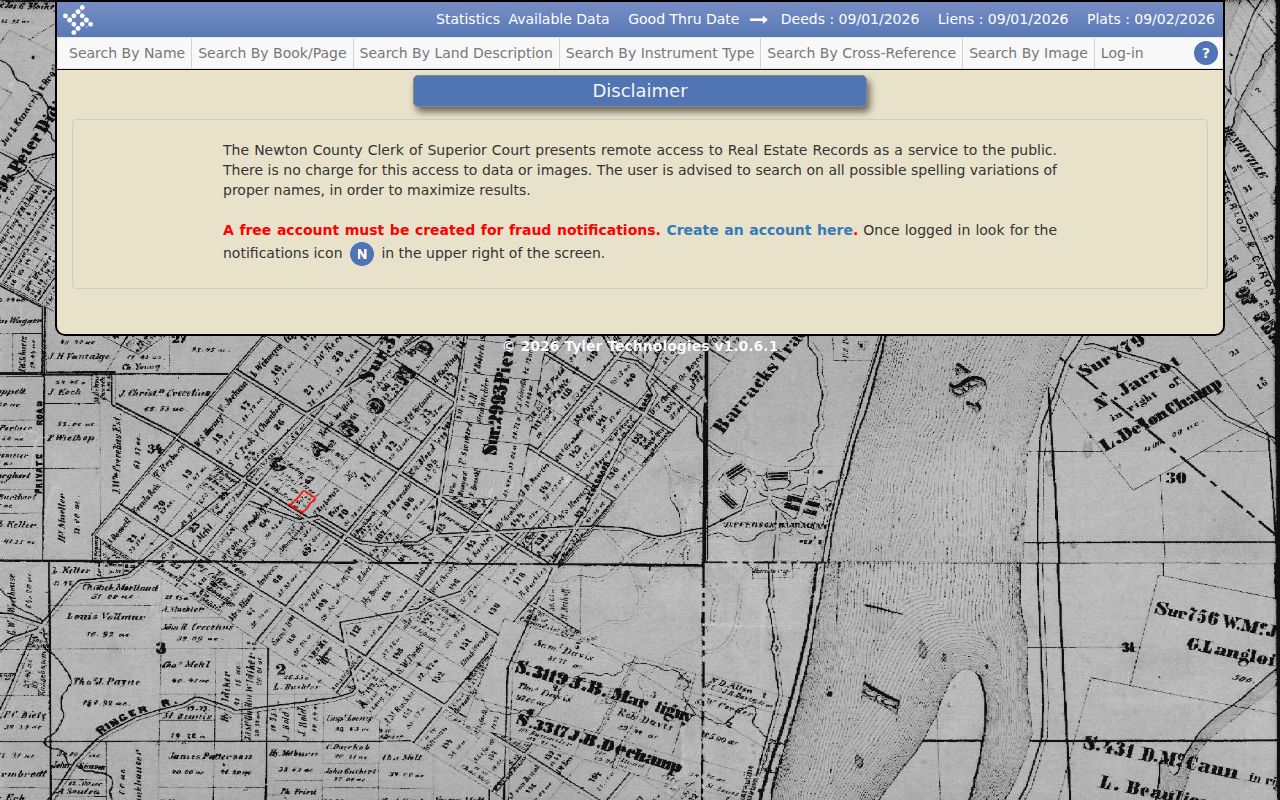
Note: Save the displayed coverage dates with your search results before the trail crosses into the handwritten indexes.
Search Newtonsboro and Other Historic Names
The county seat went by Newtonsboro until it became Covington in December 1822. Early deed records may carry that vanished name. Places like Almon, Brick Store, and Starrsville can stand in for a modern mailing city. So can Salem, Rocky Plains, and Porterdale. Treat old place names as search terms for indexes, archives, and newspapers. Then return to the legal description for proof. A local history account is only context. A deed, plat, probate instrument, or court order in the Newton County records establishes the actual transfer.
Corroborate Newton County Former Owners Locally
The Newton County Library Heritage Room holds census material, newspapers, the Georgia Death Index, and county histories. It also keeps cemetery records. Covington directory scans can link a name to an address and year. Georgia Archives and FamilySearch can point to older books as well. Record the directory year and page, the newspaper date, or the archive call number. These sources support a house-history narrative. The deed still remains the stronger ownership evidence in Newton County.
Follow Newton County Estate and Special Transfers
A tidy sale-to-sale sequence often breaks. Executor deeds, administrator deeds, gifts, quitclaims, tax deeds, foreclosures, and corrections all interrupt a chain. An heir trail usually needs probate authority plus a later recorded transfer. So search both the representative capacity and the decedent or entity name. Log the year, grantor, grantee, and instrument type. Record the legal description, consideration or qualification code, and any plat or easement reference. When the pre-1983 books remain unchecked, say "last located online" rather than claiming a complete parcel history.
Distinguish Newton County Deed Types in the Chain
Not every deed means the same thing. A warranty deed, a quitclaim, an executor deed, a tax deed, and a corrective deed each carry different context, so record the instrument label exactly and read its granting language. Security deeds, releases, liens, and plats can also shape the trail without transferring ownership. The Clerk's index is a finding tool, nothing more. When a conclusion rests on deed contents, inspect the image or order a copy. Keep the full recording citation with your Newton County property records notes.
Judge How Far Back Newton County Ownership Goes
The Clerk cites a record run from 1821 to the present. A parcel's provable chain still depends on matching every instrument. Modern addresses and parcel numbers rarely appear in the earliest books, so follow land lots, neighboring owners, legal descriptions, and plats through the Newton County records instead.
Lawful use. Former-owner research supports house history, estate work, and property diligence. Never use it to track, harass, or harm a living person.
Certified copies come through the Clerk's 24/7 eCertification service or at the counter. Confirm current charges before you order.
Tracing former owners in Newton County works best through several channels at once. The Clerk Superior Court keeps the deed books. The GSCCAA web index is one option. Researchers can also call the office, work at the counter terminals, or request certification electronically. One channel often rescues another. Blurred handwriting stops mattering when a second route covers the gap. An incomplete image stops mattering too. The remote page lists data and images as free. Separate Clerk guidance says some images must be purchased. Treat image cost as a live checkout fact. Check the GSCCCA fee schedule before quoting certified-copy charges. Every backward step demands a match stronger than a shared name. Compare the legal description, land lot, district, subdivision, lot, acreage, neighboring owners, and plat reference. Names recur in Newton County deed records. Parcels split. One former owner may have held several tracts. A deed naming the right person but different land does not belong in the chain.
Plats deserve their own check. Do this whenever the trail crosses a subdivision creation, later phase, lot split, combination, road dedication, or easement. Record the plat book and page. Also record the subdivision, phase, lot, recording date, and surveyor. Then reconcile that description with the current parcel number. Today's tax polygon may combine or divide land that looked different in a former owner's deed. The chain sometimes reaches before 1983. Bring a concise worksheet to the Clerk then. It should hold the last confirmed owner and approximate acquisition date. Add spelling variants, the legal description, land lot, district, and book and page references. Search both grantor and grantee indexes across a reasonable window. Photograph or transcribe the index citation first. After that, pull the deed book page. Confirm it concerns the same land.
Older material often lives beyond the courthouse. Georgia Archives finding aids can point to land, probate, tax, and court collections from earlier decades. The FamilySearch catalog can too. Access may require a login, an affiliate library, or staff help. Ask whether an item is an original volume. Ask whether it is an index, a transcription, or a derivative database. Keep the repository, collection, volume, page, film or image identifier, access restriction, and date checked. The Open Records process is not a substitute for deed-book research. It can produce an existing permit log, GIS dataset, or administrative record. Newton County routes deeds and liens to the Clerk. Frame any request narrowly. Use parcel, office, record type, and date range. Never ask an agency to construct a former-owner chain that does not already exist.
Label every instrument by its recorded type. Security deeds and lien releases can date financing or clear an encumbrance. Neither is an ordinary ownership transfer. A tax deed carries redemption and later title questions that a simple index row cannot resolve. Directory and newspaper evidence adds color. It places a name at an address or reports a subdivision, mill, estate, or sale. Cite the year, page, issue date, and repository. Phrase such findings as corroboration, not ownership proof. A household listing may name a resident rather than the titled owner of record. Close the project with a gap list. Record the last confirmed deed. Note the next name and date range to search. Add any missing book or image, plus the repository to contact. A transparent unfinished link beats a historical gap filled by coincidence.