
Compare the Value Figures on a Newton County Record
A Newton County property record carries several numbers, and each has a different job. Fair market value is the assessor's mass-appraisal estimate. Assessed value in Georgia generally runs 40 percent of that figure, while taxable value reflects any exemptions or reductions applied. Read the tax year and qualification code too.
| Value | What It Is | Where |
|---|---|---|
| Fair market value | County mass-appraisal estimate of full value | Assessor parcel card |
| Assessed value | Generally 40 percent of fair market value | Assessment and tax records |
| Taxable value | Value after applicable exemptions or reductions | Tax calculation |
| Last sale price | Consideration reported for one transfer | Sale table and recorded deed |
Value records split the total into land and improvement parts. That split shows how the total was composed. No single field predicts an open-market sale, because a nominal, exempt, family, estate, or otherwise unqualified transfer can carry a price that is not market evidence.
Estimate Newton County Property Value from the Official Card
The Newton Tax Office Property Search accepts owner, address, property ID, geographic ID, and advanced criteria. The portal offers tax years 2016 through 2025. Choose the intended year before comparing any figures.
- Search the address without a street prefix, suffix, or unit number, or use the parcel ID.
- Record land, improvement, total fair market, assessed, exemption, and taxable fields with the year.
- Read the sale date, price, qualification, reason, grantor, grantee, and deed reference.
- Compare only similar parcel and neighborhood context, excluding unqualified transfers.
- Assessed value
- The statutory percentage applied to fair market value before tax calculations.
- Fair market value
- The assessor's mass-appraisal estimate for the annual digest.
- Reassessment
- An updated official valuation, not a private appraisal of a specific sale.
Read Newton County's Parcel Value Fields Together
A Newton parcel card can show land value, improvement value, total or fair market value, homestead code, acreage, property class, neighborhood, building details, and sale history. Owner name, situs, mailing address, legal description, and parcel ID confirm that the correct property came up. That check matters.
Save every connected field. A vacant-lot card, a partial improvement, or a recent split can make the headline total misleading once it is separated from land area and building details. Copying one number alone invites exactly that error.
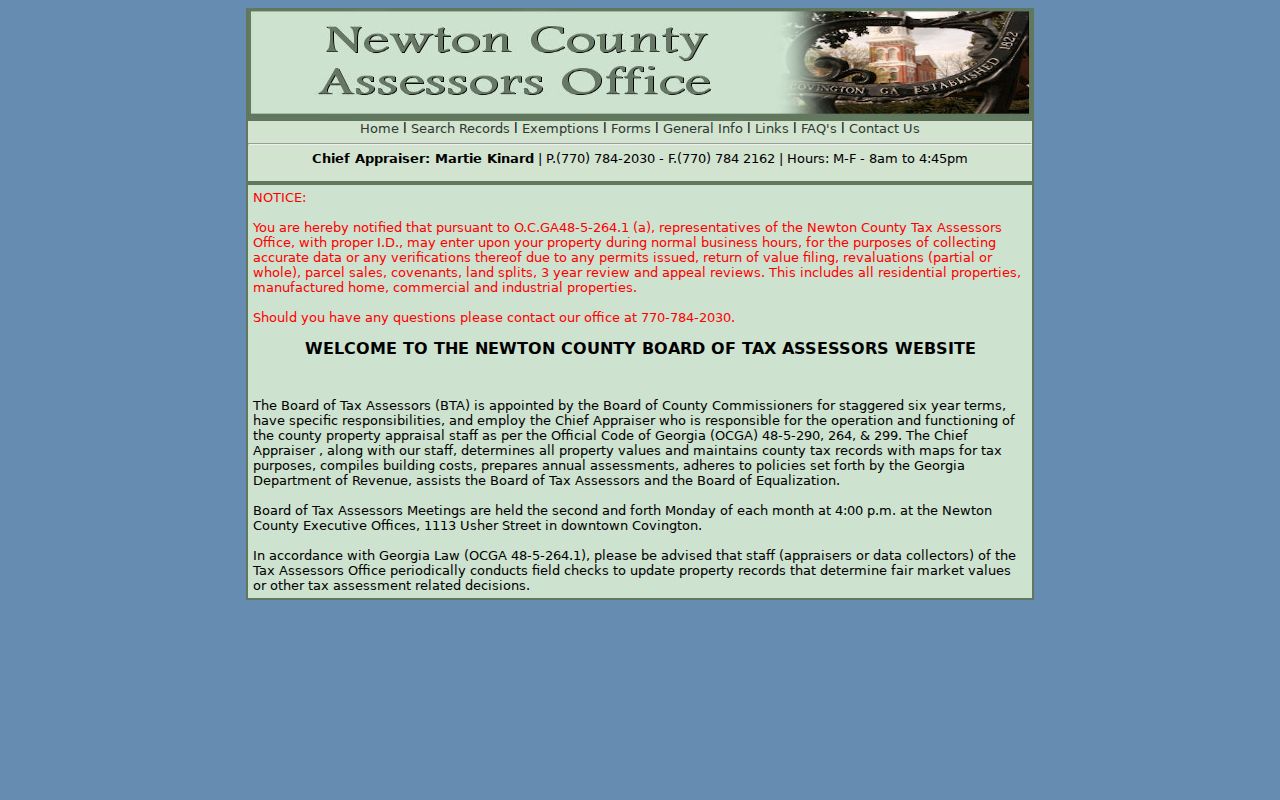
The county's qPublic entry page leads to parcel records.
Save the portal result with its tax year, parcel ID, land value, improvement value, total, and sale qualification fields. Keeping them together preserves the comparison.
Test a Newton County Sale Price Before Comparing It
An assessor sale table may list date, deed book, plat page, price, qualification, reason, grantor, and grantee. Not every price is market evidence. A gift, estate, quitclaim, exempt deal, or correction should stay out of an arm's-length comparison. When the transfer matters, follow the deed reference into the Newton Clerk Real Estate Search. Compare like with like. Use the same neighborhood, land use, acreage, improvement type, and tax-year context, and treat the assessor card as an organizing tool rather than a certified appraisal.
Separate Newton County Taxable Value from Assessed Value
Exemptions and reductions can pull taxable value away from the standard assessed figure. The 2026 Georgia home-tax relief grant reduction appears separately for eligible homesteads. It reduces assessed value by $18,000. That policy changes the tax calculation. It does not change what fair market value means.
The Tax Commissioner's published due date moves to November 15 beginning with tax year 2026. That deadline belongs to the bill process. For bills, exemptions, and appeals, see the Newton County property tax guide.
Account for Newton County's Annual Value Context
The Assessor keeps the annual digest. Cite the tax year. Add the inspection date. The office determines fair market value, and changes to structures, classification, acreage, exemptions, or neighborhood models can separate one year's card from another.
If the online search fails, call the Assessor at 770-784-2030 or visit 1113 Usher Street NE, Suite 102, Covington. An Open Records Act request can seek an existing digest export. It cannot force a new valuation or custom report.
Build a Careful Newton County Value Comparison
Start with parcels that share neighborhood context, land use, acreage, and improvement type. Keep the same tax year where possible. Drop transfers marked nominal, exempt, unqualified, or otherwise non-market. Frame it as record evidence.
Road access, easements, flood context, condition, renovations, and development limits may not appear in a simple value table. Those gaps explain why nearby values diverge. A licensed appraiser can inspect and reconcile factors the public card cannot.
Understand What Newton County Property Value Cannot Prove
The assessor figure serves the tax digest. It is not a loan appraisal. Nor is it a promise of sale price, a title opinion, or a boundary finding, and county GIS mapping is reference-only even when it helps explain location.
Value versus price. Newton County assessed value supports taxation and is not what a parcel will necessarily sell for. A licensed appraisal answers a different question.
A purchase decision calls for a current physical inspection, qualified market analysis, deed and plat review, and an appraisal suited to the intended use. Records support that work.
Some questions only the office can answer. The assessor takes calls at 770-784-2030 and meets visitors in Suite 102 at 1113 Usher Street NE. Bring the parcel ID when asking about a parcel card, tax year, exemption field, acreage, or improvement detail. Save the date of any response. The Tax Commissioner sits in Suite 101 and handles the bill, payment, delinquency, and tax-sale record rather than fair market value.
Deed verification runs through the Clerk. Search online, at a courthouse terminal, or at the Room 338 counter. A certified instrument needs eCertification. The remote index reports deeds good through September 1, 2026. Match the grantee, grantor, date, legal description, and recording number before treating the consideration as a value clue.
Open Records requests fill the gaps. An existing tax-digest export, GIS dataset, permit log, or maintained agency record can be produced on request. Name the parcel set, fields, tax year, and format. Georgia law does not require a custom appraisal or comparison report. The county may apply published search and production charges after free initial staff time.
Historical values need context. A past tax card shows what the assessor recorded for one year. A deed records one transfer. A directory can tie an address to a rough time period. None of these should be quietly adjusted into today's dollars or passed off as a current appraisal unless the method and source are stated.
Write the value math in plain layers. Start with the assessor's fair market figure. Identify the assessed amount under Georgia's forty-percent framework. Then note any exemptions or reductions that produce taxable value. Keep the actual bill and balance separate, because millage, fees, payments, interest, and penalties belong to the Tax Commissioner's record rather than the appraisal field.
Preserve the qualification fields on sale history. A low price may signal a gift, family transfer, estate, foreclosure, quitclaim, correction, or exempt deal rather than an open-market sale. Read the matched deed first. Keep an unqualified sale out of any comparison unless its special context is exactly the point.
Land and improvement figures need physical context. Acreage, land type, building characteristics, accessory improvements, neighborhood code, and current condition can explain gaps between nearby parcels. The public card holds administrative facts and mass-appraisal inputs. It will not show every defect, renovation, access issue, easement, or market condition that a licensed appraiser would inspect.
Close each value note with an audit trail. List the parcel ID, tax year, inspection date, value type, and source. Say whether each sale was qualified. Note whether exemptions touched taxable value. That record lets a later reader compare like with like after the portal changes.